The last few years have seen the creation of blockchain projects that claim to have tokens backed by physical gold. In October, Coinshares and Blockchain.com launched a digital gold token (DGLD) backed by physical gold that uses BTC’s security. Tether just announced a new token called tether gold (XAUT), which will be listed for trading on Bitfinex. The company that created the dominant stablecoin USDT claims a single XAUT token represents one troy fine ounce of gold.
Also read: Data Shows $25 Billion Worth of Bitcoin and Ether Held by Seven Crypto Exchanges
While 30 Gold-Backed Crypto Attempts Have Failed, 77 Existing Blockchain Projects Attempt to Leverage the Precious Metal’s Backing
The narrative that BTC is “digital gold” has been embraced by maximalists in recent years, but despite this people are still creating gold-backed tokens that utilize blockchain technology. There’s a bunch of blockchain networks that claim to leverage physical gold to back certain tokens. For instance, Digixglobal has a token called DGX, which represents 1 gram of 99% LMBA standard gold. Additionally, there’s also darico (DEC), blocknote (BNO), aurusgold (AWG), cash telex (CTLX), blockstock (BSO), tether gold (XAUT), Coinshares/Blockchain.com MKS (DGLD), g-coin (XGC), goldnugget (GNTO), goldmint (MNTP), goldfund (GFUN), gramgold coin (GGC), pax gold (PAXG), karatgold coin (KBC), and hellogold (HGT).

That list doesn’t even scratch the surface of gold-backed tokens that exist today, as there are a ton more projects that have followed the same path. According to data recorded on January 12, 2020, there are over 30 dead gold crypto projects that have failed over the years. There are also roughly 77 gold-backed blockchain concepts, initial coin offerings (ICO), and gold-backed token projects that exist in the wild today.
DGLD and XAUT Enter the Gold-Backed Crypto Competition
Despite the fact that people think BTC is digital gold and the recent marketing attempts to “drop gold,” gold-backed tokens are still enticing blockchain creators and investors. The latest two gold offerings stem from the firms Coinshares, Blockchain.com, the precious metal trader MKS, and Tether. The UK-based firm Coinshares claims to have launched $20 million worth of gold into a digital blockchain secured by the BTC network. The company asserts each DGLD is backed by 1/10th of a troy ounce of fine gold. The coin can be bought and sold using Blockchain.com’s trading platform the Pit, and DGLD runs on the BTC chain by using Commerceblock’s sidechain. The launch last October saw some fanfare, but DGLD is not available to residents of Canada or the U.S.

Tether’s XAUT launched last week and Bitfinex announced listing tether gold token on January 24. “XAUT is a digital asset offered by TG Commodities Limited [and] one XAUT token represents one troy fine ounce of gold on a London Good Delivery gold bar,” explained the Bitfinex announcement on Friday. The trading platform emphasized that XAUT token owners enjoy the “combined benefits of both physical and digital assets.” Essentially, users avoid the “drawbacks associated with physical gold, such as high storage costs and limited accessibility,” the Bitfinex blog announcement noted. The pax gold (PAXG) token project is similar, for it promises that each token’s redemption is backed by one fine troy ounce London Good Delivery gold bar.

Well known crypto proponent John Paul Koning questions if projects like PAXG and XAUT and other gold-backed cryptos are sustainable. “Interesting — Unlike traditional gold storage options, blockchain gold products like XAUT, Pax Gold, and DGX don’t charge custody fees, just redemption/transaction fees. Is that sustainable?” Koning tweeted on Friday. Brandon Arvanaghi, the chief security officer of the vertically-integrated Bitcoin mining company Layer1, responded “No, in part because the transaction fees are fickle. Offchain: any trading on a centralized exchange avoids them [and] Onchain: create a ‘wrapper’ contract that owns several of the underlying tokens. Allow trading synthetics in the wrapper.”
Are Today’s 77 Gold-Backed Crypto Projects Any Less Centralized Than E-Gold’s Attempt in 1996?
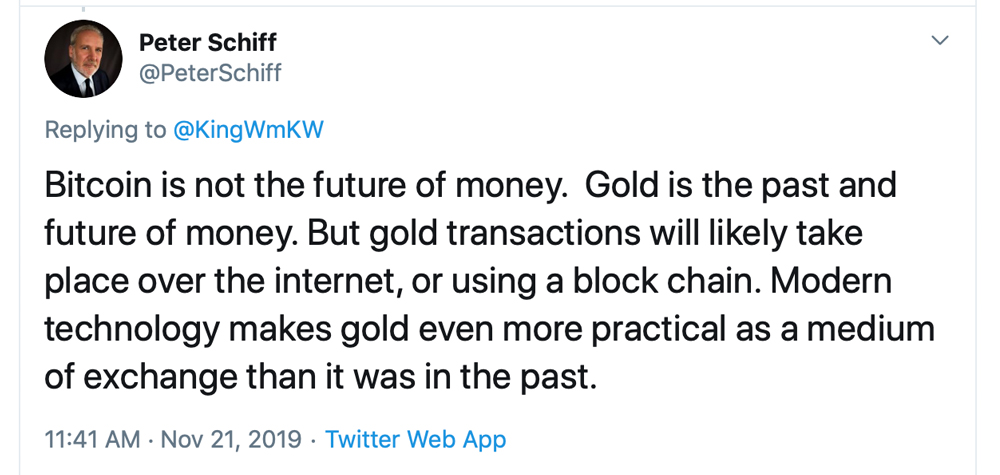
Despite the fact that much older projects like e-gold and Liberty Reserve fell by the wayside, the attempt to create a perfect gold-backed token has been somewhat of a holy grail. According to the gold bug Peter Schiff, a precious-metal backed cryptocurrency would likely trump coins like BTC because he believes BTC is backed by “nothing.” However, e-gold failed miserably, even though the creator tried to offer features like micropayments and a decentralized governance system. E-gold’s tenure ended rather quickly because the project was a centralized entity that failed to keep up with KYC/AML guidelines and the Patriot Act’s money transmission laws.

Most of the blockchain gold projects today use a distributed ledger system, but that doesn’t make the project any less centralized than e-gold’s attempt. As far as market share goes, most of the aforementioned gold-backed tokens have extremely small market valuations and a decent portion of these projects are not even listed on crypto capitalization websites. Karatgold (KBC) has a market capitalization of around $65 million but only sees $200,000 worth of global trade volume. Digixglobal’s digix gold token (DGX) has a $6 million market capitalization and $193,000 worth of trade volume. Both KBC and DGX’s combined daily trade volume pales in comparison to tether (USDT) $602 million, BTC $529 million, and bitcoin cash (BCH) $30 million. Shiny metal backed tokens have a long way to go to catch up to their fiat companions’ (stablecoins) trade volume and network activity.
What do you think about the gold-backed cryptocurrency attempts over the years? Do you think that gold-backed tokens are something that will stick around or even overtake a digital asset like BTC? Let us know what you think about this subject in the comments section below.
Disclaimer: This article is for informational purposes only. It is not an offer or solicitation of an offer to buy or sell, or a recommendation, endorsement, or sponsorship of any gold crypto products, gold-crypto services, or any of the aforementioned projects/companies. Bitcoin.com does not provide investment, tax, legal, or accounting advice. Neither the company nor the author is responsible, directly or indirectly, for any damage or loss caused or alleged to be caused by or in connection with the use of or reliance on any content, goods or services mentioned in this article.
Image credits: Shutterstock, Tether.to, DGLD logo, Wiki Commons, Fair Use, Twitter, and Pixabay.
Did you know you can buy and sell BCH privately using our noncustodial, peer-to-peer Local Bitcoin Cash trading platform? The local.Bitcoin.com marketplace has thousands of participants from all around the world trading BCH right now. And if you need a bitcoin wallet to securely store your coins, you can download one from us here.
The post More Than 77 Crypto Projects Claim to Be Backed by Physical Gold appeared first on Bitcoin News.
from Bitcoin News https://ift.tt/38ACNMu
Comments
Post a Comment