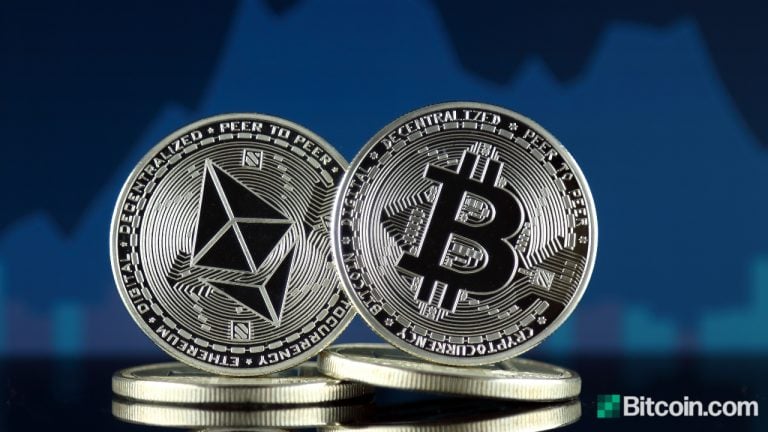
Bitcoin vs Ethereum: Investment Bank JPMorgan Explains Why ETH Is Outperforming BTC

Bitcoin vs Ethereum: JPMorgan Explains Why ETH Is Outperforming BTC

Investment bank JPMorgan has published a report explaining why ether is outperforming bitcoin. Citing several key reasons, the firm concluded that “there is evidence of more resilient liquidity, less reliance on derivatives markets to transfer and warehouse risk, and more durable underlying demand base – for now at least.”

JPMorgan Says Ether Outperforms Bitcoin

JPMorgan published a report on Tuesday entitled “Why is ETH outperforming?” The analysts with the firm’s Fixed Income Strategy for the U.S. wrote:

In recent days, one of the more interesting developments in cryptocurrency markets has been the outperformance of ether (ETH) relative to other tokens.

Noting that bitcoin is “more of a crypto commodity than currency,” JPMorgan said that “ETH is the backbone of the crypto-native economy and therefore functions more as a medium of exchange.” The analysts then asserted that “To the extent owning a share of this potential activity is more valuable … ETH should outperform BTC over the long run.”

While the JPMorgan analysts noted that “Both BTC and ETH markets experienced a comparable liquidity shock earlier this month which triggered a comparable de-levering of their perspective derivatives market in subsequent days,” they pointed out:

But ETH spot market depth has recovered quicker and if anything liquidity conditions on some exchanges is better than prior to the event.

The analysts further explained that “High-frequency cash/futures basis pricing reveals a much smaller impact in ETH markets despite optically comparable net liquidations.” Furthermore, “open interest data also suggests that the other side of these trades was easier to source.”

The report continues: “Higher turnover on the public ETH blockchain means a noticeably higher fraction of those tokens can be considered highly liquid, further blunting the impact of futures liquidations.”

The JPMorgan analysts further detailed: “In the case of ether versus bitcoin, there is evidence of more resilient liquidity, less reliance on derivatives markets to transfer and warehouse risk, and more durable underlying demand base – for now at least.”

The report adds that “In combination with the continued growth of Defi and other components of the ethereum-based economy, this suggests some technical but occasionally important bullish tailwinds versus bitcoin.” The analysts concluded:

ETH valuations may be less dependent on levered demand than BTC, a technical but occasionally important tailwind going forward.

Do you agree with JPMorgan on ether outperforming bitcoin? Let us know in the comments section below.


from Bitcoin News https://ift.tt/3gVOncJ

Comments

Popular posts from this blog

Mt Gox Creditors Updated, Trustee Says Rehabilitation Custodian Is ‘Currently Preparing to Make Repayments’

On August 31, 2022, the Mt Gox trustee Nobuaki Kobayashi explained in a recent letter that the rehabilitation custodian is “currently preparing to make repayments” to Mt Gox creditors. Trustee Updates Mt Gox Creditors — Repayment Date and Exchange Still Unknown Last week speculation and rumors concerning the release of 140K bitcoin ( BTC ) from Mt Gox littered social media platforms and headlines. Bitcoin.com News covered the situation six days ago as a number of people and Mt Gox creditors called the rumors “ fake news .” During that same period of time, a bitcoin whale transferred 10,000 BTC to unknown wallets, and a 2018 annotation , heuristics, and clustering methods show the funds likely originated from the June 2011 Mt Gox hacks. Following the mysterious whale transfer, last Wednesday, Mt Gox published an official update from the court trustee Nobuaki Kobayashi that explains the court is “currently preparing to make repayments” to creditors. Mt Gox creditors have been wait...

Economists Discuss Russia, China Potentially Developing Gold-Backed Currency That Could Undermine US Dollar

Economists have weighed in on reports that China and Russia may be developing a new gold-backed currency that could undermine the U.S. dollar’s status as the world’s primary reserve currency. Russia and China May Be Developing Gold-Backed Currency Several experts have shared their views on Russia and China potentially creating a new gold-baked currency, Fox Business reported Saturday, emphasizing that China has been buying up huge quantities of gold while Russia was forced off the U.S. dollar due to sanctions imposed on the country following its invasion of Ukraine. The news outlet noted that some experts have cautioned that these moves, along with the closer relationship that has developed between Moscow and Beijing, point to the likelihood of China attempting to launch a gold-backed currency. However, neither Russia nor China has officially confirmed plans for such a currency. Craig Singleton, senior fellow at the Foundation for Defense of Democracies and a former U.S. diplomat,...

Fidelity Discusses Bitcoin as Portfolio Insurance — Could Soon Stand in ‘Stark Contrast’ to Path Fiat Currencies Take

Fidelity Digital Assets, a subsidiary of Fidelity Investments, says that bitcoin could be considered portfolio insurance. The firm notes that the cryptocurrency “may soon stand in stark contrast to the path that the rest of the world and fiat currencies may take — namely the path of increased supply, additional currency creation, and central bank balance sheet expansion.” Fidelity Says Bitcoin Could Be Portfolio Insurance Fidelity Digital Assets, a subsidiary of Fidelity Investments, recently published a research study titled “The Rising Dollar and Bitcoin.” The research outlines “how bitcoin could be considered portfolio insurance” as the rising dollar impacts global currency markets. “The strengthening U.S. dollar is wreaking havoc among other countries and may put pressure on the Federal Reserve to soon reverse its tightening monetary actions, something that has precedent based on 1985’s Plaza Accord,” Fidelity explained. In addition, “more monetary debasement may be needed to ...