The Top Privacy Coins Saw Fewer Percentage Losses Than Most Tokens This Week

The Top Privacy Coins Saw Fewer Percentage Losses Than Most Tokens This Week

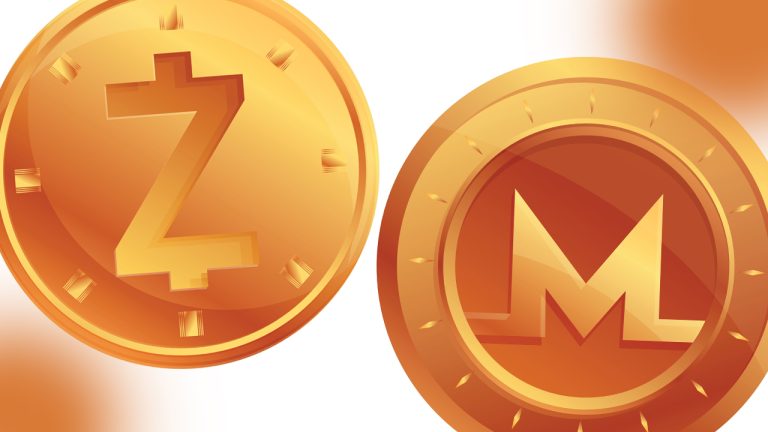
The privacy coins monero and zcash managed to see fewer percentage losses against the U.S. dollar this week, in contrast to crypto assets like bitcoin, ethereum, and solana. Seven-day statistics indicate zcash has lost 5.6% against the USD, while monero dropped by 6.1%.

Privacy Coins Manage to Stave off Some of This Week’s Market Carnage, but Are Still Down 62% Lower Than 9 Months Ago

At the time of writing, the entire market capitalization of all the privacy coins in existence is roughly $5.55 billion. Monero (XMR) leads the pack with a market valuation of around $2.64 billion or 47.5% of the entire privacy coin economy. Zcash (ZEC) is the second largest privacy coin in terms of market capitalization as ZEC’s overall market valuation today is $789 million.

Behind XMR and ZEC, are privacy tokens such as decred (DCR), nucypher (NU), secret (SCRT), horizen (ZEN), ergo (ERG), digibyte (DGB), and beldex (BDX), respectively. Top privacy coin double-digit gainers this week include deeponion (ONION), litecash (CASH), pivx (PIVX), and masari (MSR). The week’s top privacy coin losers in terms of percentage losses include tokens like zclassic (ZCL), lethean (LTHN), and phore (PHR).

The top five privacy coin crypto assets make up most of the $5.55 billion in privacy coin value, and each token offers different types of privacy techniques. XMR is a Cryptonote token with a blockchain protocol that was not forked from Bitcoin. XMR uses ring signatures, ring confidential transactions, stealth addresses, bulletproofs, and Dandelion++. The ZEC network can shield transactions by leveraging a zero-knowledge proof called zk-SNARKs.

Decred (DCR) utilizes a Coinjoin mixing scheme called Coinshuffle++ (CSPP) to obfuscate transactions. Nucypher (NU) deploys Proxy Re-Encryption (PRE), a technology that allows the owner of the private key to encrypt data. Similar to NU, the Secret (SCRT) blockchain provides key management techniques, Trusted Execution Environment (TEE) schemes combined with encryption to enhance privacy.

While privacy coins have taken less of a beating this week compared to ETH or BTC, they still have lost quite a bit of value during the last year. Four months ago the privacy crypto coin economy was worth a whole lot more, at $10.7 billion. XMR’s overall market valuation was $4.13 billion and ZEC’s was $1.84 billion on April 28, 2022. Nine months ago on November 6, 2021, the privacy token economy was worth $14.9 billion.

At that time in November 2021, NU was not in the top five, as horizen (ZEN) held the fifth position in terms of privacy coins by market cap. XMR’s overall market valuation was $4.69 billion. ZEC’s market capitalization on November 6, 2021 was slightly higher than the April 28, 2022 record with $1.94 billion. In November 2021, XMR’s and ZEC’s market caps combined were larger than today’s privacy coin economy value.

What do you think about the privacy coin market action in recent times? Let us know what you think about this subject in the comments section below.


from Bitcoin News https://ift.tt/L2kiXy5

Comments

Popular posts from this blog

Mt Gox Creditors Updated, Trustee Says Rehabilitation Custodian Is ‘Currently Preparing to Make Repayments’

On August 31, 2022, the Mt Gox trustee Nobuaki Kobayashi explained in a recent letter that the rehabilitation custodian is “currently preparing to make repayments” to Mt Gox creditors. Trustee Updates Mt Gox Creditors — Repayment Date and Exchange Still Unknown Last week speculation and rumors concerning the release of 140K bitcoin ( BTC ) from Mt Gox littered social media platforms and headlines. Bitcoin.com News covered the situation six days ago as a number of people and Mt Gox creditors called the rumors “ fake news .” During that same period of time, a bitcoin whale transferred 10,000 BTC to unknown wallets, and a 2018 annotation , heuristics, and clustering methods show the funds likely originated from the June 2011 Mt Gox hacks. Following the mysterious whale transfer, last Wednesday, Mt Gox published an official update from the court trustee Nobuaki Kobayashi that explains the court is “currently preparing to make repayments” to creditors. Mt Gox creditors have been wait...

Fidelity Discusses Bitcoin as Portfolio Insurance — Could Soon Stand in ‘Stark Contrast’ to Path Fiat Currencies Take

Fidelity Digital Assets, a subsidiary of Fidelity Investments, says that bitcoin could be considered portfolio insurance. The firm notes that the cryptocurrency “may soon stand in stark contrast to the path that the rest of the world and fiat currencies may take — namely the path of increased supply, additional currency creation, and central bank balance sheet expansion.” Fidelity Says Bitcoin Could Be Portfolio Insurance Fidelity Digital Assets, a subsidiary of Fidelity Investments, recently published a research study titled “The Rising Dollar and Bitcoin.” The research outlines “how bitcoin could be considered portfolio insurance” as the rising dollar impacts global currency markets. “The strengthening U.S. dollar is wreaking havoc among other countries and may put pressure on the Federal Reserve to soon reverse its tightening monetary actions, something that has precedent based on 1985’s Plaza Accord,” Fidelity explained. In addition, “more monetary debasement may be needed to ...

Economists Discuss Russia, China Potentially Developing Gold-Backed Currency That Could Undermine US Dollar

Economists have weighed in on reports that China and Russia may be developing a new gold-backed currency that could undermine the U.S. dollar’s status as the world’s primary reserve currency. Russia and China May Be Developing Gold-Backed Currency Several experts have shared their views on Russia and China potentially creating a new gold-baked currency, Fox Business reported Saturday, emphasizing that China has been buying up huge quantities of gold while Russia was forced off the U.S. dollar due to sanctions imposed on the country following its invasion of Ukraine. The news outlet noted that some experts have cautioned that these moves, along with the closer relationship that has developed between Moscow and Beijing, point to the likelihood of China attempting to launch a gold-backed currency. However, neither Russia nor China has officially confirmed plans for such a currency. Craig Singleton, senior fellow at the Foundation for Defense of Democracies and a former U.S. diplomat,...