
Japan’s Inflation Surges to 3.5% as New BOJ Governor Takes the Helm

Japan's Inflation Surges to 3.5% as New BOJ Governor Takes the Helm

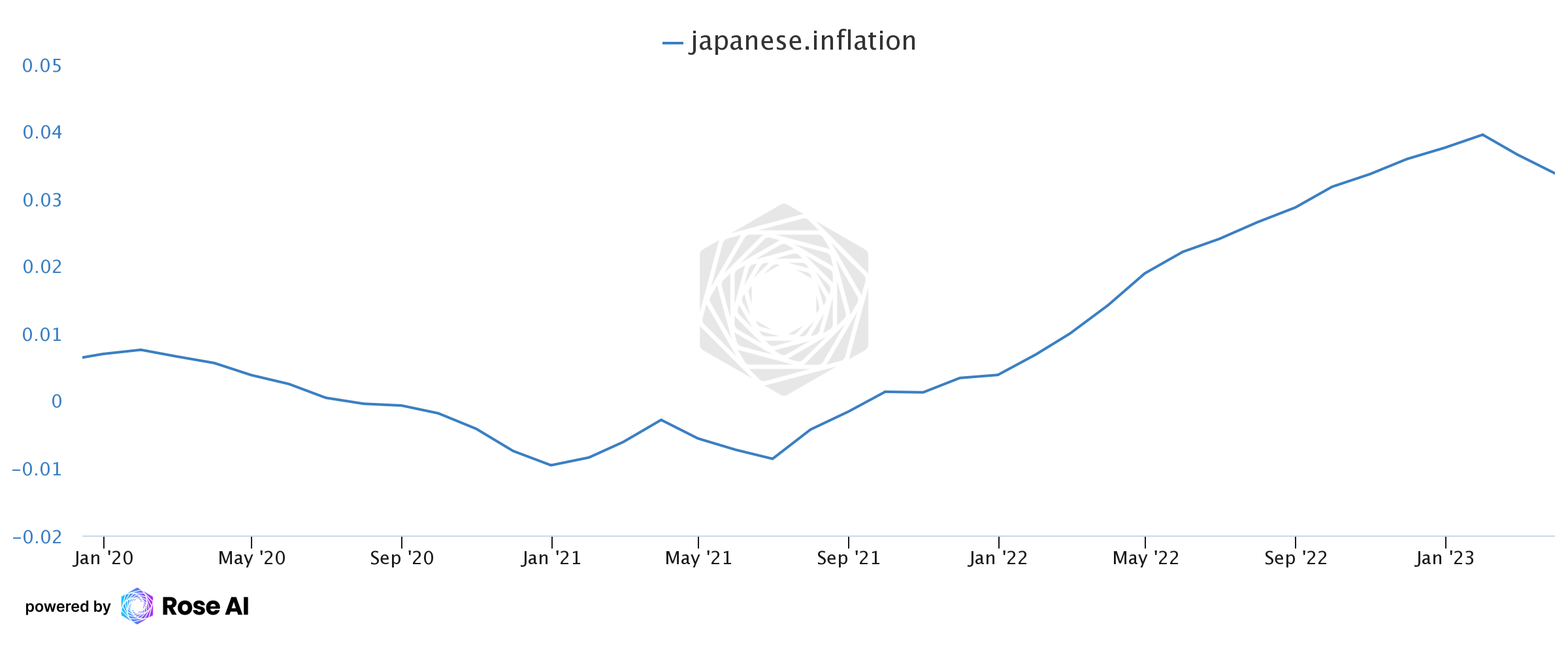
This week, the Statistics Bureau of Japan unveiled the latest core consumer price index (CPI) report for the country, revealing a surge to 3.5%. This figure comes as a surprise to analysts who had predicted a more modest 2.9% for the end of the quarter. It’s worth noting that Japan’s inflation has been steadily rising since June 2021. The timing of this uptick is also notable, as Kazuo Ueda has recently assumed the role of the 32nd governor of the Bank of Japan.

New BOJ Governor Faces Rising Inflation, Central Bank to Conduct Review of Monetary Policy Measures

In April, Japan experienced a surge in its year-over-year inflation rate — excluding fresh food and energy prices — which increased to 3.5%. This worsening inflation rate is a concern for the Bank of Japan (BOJ), which aims to bring the rate back down to the 2% range, like several central banks worldwide. However, the country’s economy is facing significant challenges, including the aftermath of the Covid-19 pandemic, which resulted in substantial stimulus measures and lockdown policies.

Moreover, Japan is grappling with a shrinking workforce, which could significantly affect its ability to sustain economic growth. These challenges are compounded by the fact that the BOJ has a new governor, Kazuo Ueda, who addressed his first monetary policy meetings on April 27 and 28. Ueda, a Japanese economist, has opted to keep interest rates unchanged, maintaining the negative rate that Japan has held since 2016.
Japan's Inflation Surges to 3.5% as New BOJ Governor Takes the Helm

‘The Last and Final Source of Excess Liquidity’

The recent news is likely to add pressure on the BOJ to address the country’s accelerating inflation rate. The central bank, however, stated that it has “decided to conduct a broad-perspective review” of its monetary policy measures, indicating that it may explore new approaches to stabilize the economy. As the BOJ grapples with these challenges, it remains to be seen how it will navigate Japan’s economic future.

“With extremely high uncertainties surrounding economies and financial markets at home and abroad, the bank will patiently continue with monetary easing while nimbly responding to developments in economic activity and prices as well as financial conditions,” the BOJ announcement notes. “By doing so, it will aim to achieve the price stability target of 2 percent in a sustainable and stable manner, accompanied by wage increases.”

Overall, the country’s recent CPI report highlights the challenges that Japan’s economy is facing. On Friday, Hiromi Yamaoka, a former BOJ official, told CNBC’s “Squawk Box Asia” that “there remains some uncertainty in the Japanese real economy, but at the same time, inflationary pressures is becoming more imminent.”

Graham Summers, an MBA at Phoenix Capital Research, believes that Japan may be the final straw in terms of liquidity. On Friday, Summers wrote, “With inflation surging in Japan, the Bank of Japan will soon be forced to end its money printing, which means the financial system would lose its last and final source of excess liquidity.”

What do you think the BOJ’s broad-perspective review of its monetary policy measures will entail, and how do you believe it will impact Japan’s economic future? Share your thoughts in the comments section below.


from Bitcoin News https://ift.tt/uJZKQ9O

Comments

Popular posts from this blog

Mt Gox Creditors Updated, Trustee Says Rehabilitation Custodian Is ‘Currently Preparing to Make Repayments’

On August 31, 2022, the Mt Gox trustee Nobuaki Kobayashi explained in a recent letter that the rehabilitation custodian is “currently preparing to make repayments” to Mt Gox creditors. Trustee Updates Mt Gox Creditors — Repayment Date and Exchange Still Unknown Last week speculation and rumors concerning the release of 140K bitcoin ( BTC ) from Mt Gox littered social media platforms and headlines. Bitcoin.com News covered the situation six days ago as a number of people and Mt Gox creditors called the rumors “ fake news .” During that same period of time, a bitcoin whale transferred 10,000 BTC to unknown wallets, and a 2018 annotation , heuristics, and clustering methods show the funds likely originated from the June 2011 Mt Gox hacks. Following the mysterious whale transfer, last Wednesday, Mt Gox published an official update from the court trustee Nobuaki Kobayashi that explains the court is “currently preparing to make repayments” to creditors. Mt Gox creditors have been wait...

Economists Discuss Russia, China Potentially Developing Gold-Backed Currency That Could Undermine US Dollar

Economists have weighed in on reports that China and Russia may be developing a new gold-backed currency that could undermine the U.S. dollar’s status as the world’s primary reserve currency. Russia and China May Be Developing Gold-Backed Currency Several experts have shared their views on Russia and China potentially creating a new gold-baked currency, Fox Business reported Saturday, emphasizing that China has been buying up huge quantities of gold while Russia was forced off the U.S. dollar due to sanctions imposed on the country following its invasion of Ukraine. The news outlet noted that some experts have cautioned that these moves, along with the closer relationship that has developed between Moscow and Beijing, point to the likelihood of China attempting to launch a gold-backed currency. However, neither Russia nor China has officially confirmed plans for such a currency. Craig Singleton, senior fellow at the Foundation for Defense of Democracies and a former U.S. diplomat,...

Fidelity Discusses Bitcoin as Portfolio Insurance — Could Soon Stand in ‘Stark Contrast’ to Path Fiat Currencies Take

Fidelity Digital Assets, a subsidiary of Fidelity Investments, says that bitcoin could be considered portfolio insurance. The firm notes that the cryptocurrency “may soon stand in stark contrast to the path that the rest of the world and fiat currencies may take — namely the path of increased supply, additional currency creation, and central bank balance sheet expansion.” Fidelity Says Bitcoin Could Be Portfolio Insurance Fidelity Digital Assets, a subsidiary of Fidelity Investments, recently published a research study titled “The Rising Dollar and Bitcoin.” The research outlines “how bitcoin could be considered portfolio insurance” as the rising dollar impacts global currency markets. “The strengthening U.S. dollar is wreaking havoc among other countries and may put pressure on the Federal Reserve to soon reverse its tightening monetary actions, something that has precedent based on 1985’s Plaza Accord,” Fidelity explained. In addition, “more monetary debasement may be needed to ...