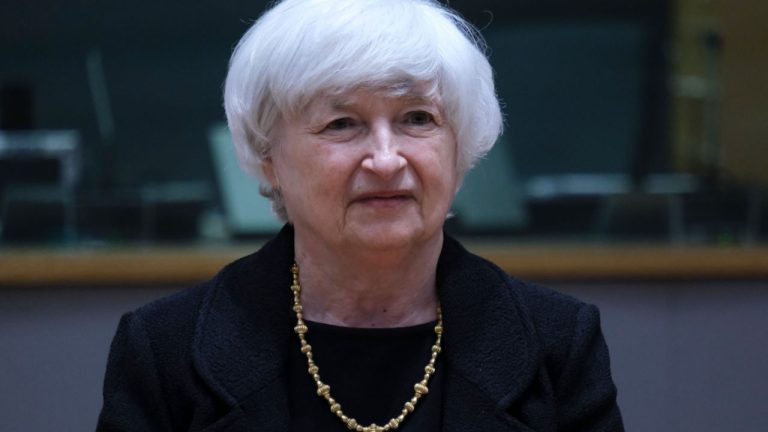
US Treasury Secretary Janet Yellen Acknowledges Sanctions Weaponization Could Hurt Dollar Hegemony

US treasury secretary yellen dollar sanctions

U.S. Treasury Secretary Janet Yellen talked about the dangers that sanctions based on the U.S. dollar might pose for the hegemony of the currency in international markets. According to Yellen, the government tries to use sanctions “judiciously,” as they can create a desire to find alternatives to the U.S. dollar.

U.S. Treasury Secretary Yellen Talks Dangers of Dollar Weaponization

Janet Yellen, Treasury Secretary of the United States, has referred to the possible effects that continued use of sanctions could exert on the hegemony of the U.S. dollar in international markets. In an interview reviewed by Reuters, Yelled acknowledged that such a danger does exist in the long term.

On the issue, she stated:

So, there is a risk when we use financial sanctions that are linked to the role of the dollar, that over time it could undermine the hegemony of the dollar, as you said. But this is an extremely important tool we try to use judiciously.

Yellen recognizes that such sanctions push countries like China and Russia to seek alternatives to the U.S. dollar, in order to conduct trades even when affected by these sanctions. However, she also explained that this is no easy task due to the unique traits of the dollar. Yellen expanded on this, declaring:

We haven’t seen any other country that has the basic infrastructure – institutional infrastructure – that would enable its currency to serve the world like this.

This is the same conclusion that a report from the Bank of Russia, titled “Review of the Russian Financial Sector and Financial Instruments” reached, stating that substituting the U.S. dollar will be difficult due to the current structure of foreign trade.

Sanctioned Countries Seek Alternatives

Even with all the difficulties, countries with individuals and entities sanctioned by the Office of Foreign Asset Control (OFAC) like China, Russia, and Iran, are starting to develop integration policies that allow them to conduct trade away from the U.S. dollar.

China and Russia have already started to conduct settlement transactions using the Chinese yuan, leveraging specially designated banks as clearing entities to facilitate these payments. In his recent visit to China, Brazilian President Luiz Inacio ‘Lula’ da Silva called for developing nations to abandon the U.S. dollar and for BRICS to establish a new currency.

The insurance of a BRICS currency will be debated at the next BRICS summit, which will be held in South Africa in August, according to statements from a Russian State Duma official. Russia and Iran are also finalizing an agreement to deepen their trade collaboration, avoiding the crippling sanctions that the U.S. has enacted against them.

What do you think about U.S. Treasury Secretary Yellen’s stance on sanctions and the future of the U.S. dollar? Tell us in the comment section below.


from Bitcoin News https://ift.tt/K0pz75N

Comments

Popular posts from this blog

Mt Gox Creditors Updated, Trustee Says Rehabilitation Custodian Is ‘Currently Preparing to Make Repayments’

On August 31, 2022, the Mt Gox trustee Nobuaki Kobayashi explained in a recent letter that the rehabilitation custodian is “currently preparing to make repayments” to Mt Gox creditors. Trustee Updates Mt Gox Creditors — Repayment Date and Exchange Still Unknown Last week speculation and rumors concerning the release of 140K bitcoin ( BTC ) from Mt Gox littered social media platforms and headlines. Bitcoin.com News covered the situation six days ago as a number of people and Mt Gox creditors called the rumors “ fake news .” During that same period of time, a bitcoin whale transferred 10,000 BTC to unknown wallets, and a 2018 annotation , heuristics, and clustering methods show the funds likely originated from the June 2011 Mt Gox hacks. Following the mysterious whale transfer, last Wednesday, Mt Gox published an official update from the court trustee Nobuaki Kobayashi that explains the court is “currently preparing to make repayments” to creditors. Mt Gox creditors have been wait...

Economists Discuss Russia, China Potentially Developing Gold-Backed Currency That Could Undermine US Dollar

Economists have weighed in on reports that China and Russia may be developing a new gold-backed currency that could undermine the U.S. dollar’s status as the world’s primary reserve currency. Russia and China May Be Developing Gold-Backed Currency Several experts have shared their views on Russia and China potentially creating a new gold-baked currency, Fox Business reported Saturday, emphasizing that China has been buying up huge quantities of gold while Russia was forced off the U.S. dollar due to sanctions imposed on the country following its invasion of Ukraine. The news outlet noted that some experts have cautioned that these moves, along with the closer relationship that has developed between Moscow and Beijing, point to the likelihood of China attempting to launch a gold-backed currency. However, neither Russia nor China has officially confirmed plans for such a currency. Craig Singleton, senior fellow at the Foundation for Defense of Democracies and a former U.S. diplomat,...

Fidelity Discusses Bitcoin as Portfolio Insurance — Could Soon Stand in ‘Stark Contrast’ to Path Fiat Currencies Take

Fidelity Digital Assets, a subsidiary of Fidelity Investments, says that bitcoin could be considered portfolio insurance. The firm notes that the cryptocurrency “may soon stand in stark contrast to the path that the rest of the world and fiat currencies may take — namely the path of increased supply, additional currency creation, and central bank balance sheet expansion.” Fidelity Says Bitcoin Could Be Portfolio Insurance Fidelity Digital Assets, a subsidiary of Fidelity Investments, recently published a research study titled “The Rising Dollar and Bitcoin.” The research outlines “how bitcoin could be considered portfolio insurance” as the rising dollar impacts global currency markets. “The strengthening U.S. dollar is wreaking havoc among other countries and may put pressure on the Federal Reserve to soon reverse its tightening monetary actions, something that has precedent based on 1985’s Plaza Accord,” Fidelity explained. In addition, “more monetary debasement may be needed to ...