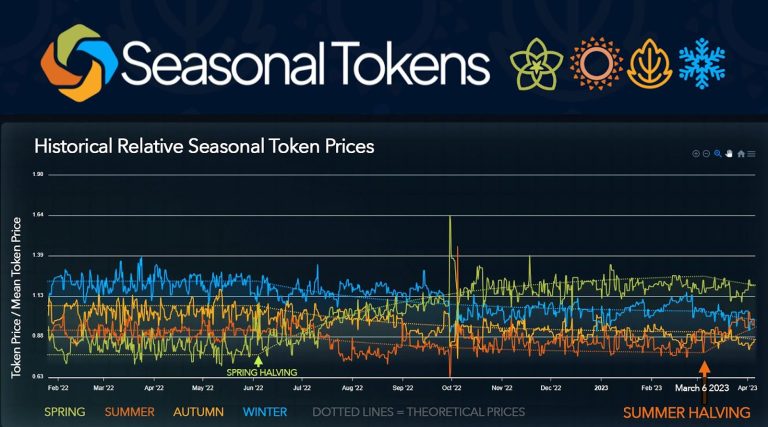
PRESS RELEASE. The Seasonal Tokens economy has gone through its second change of season. Like bitcoin, the four tokens – Spring, Summer, Autumn and Winter – go through regular halvings of the supply from mining. Every nine months, the rate of production of one of the tokens is cut in half. On the 6th of March, the Summer halving took place. Summer went from being produced at the fastest rate of the four tokens, to the slowest.
As the market adjusts to the lower rate of supply after a halving, the token that was previously the cheapest gradually becomes the most expensive. This happened with Spring after its halving in June of last year. The same process is now unfolding with Summer. Autumn tokens, which are now produced at the fastest rate of the four, have become the cheapest token, and can be expected to remain that way until the Autumn halving in December. Meanwhile, Summer is rising and is now tied with Winter for second place.
The tokens are designed to slowly cycle around each other in price so that traders can take advantage of the predictable price changes and accumulate holdings over time. The rule for successful trading is simple: Always trade tokens for more tokens of a different type. This eliminates the risk of making a loss, measured in tokens, and it guarantees that the total number of tokens held increases with every trade.
Before June 2022, a trader could get between 40% and 60% more tokens in total by trading Winter for Spring. After November, when Spring was the most expensive of the four, those traders could trade Spring for Summer and gain more tokens in total once again. Over the coming months, Summer will tend to become the most expensive token, giving traders a third chance to increase their holdings without spending more money.
Like bitcoin, the tokens become harder to obtain over time, making them suitable for use as a store of value. Unlike bitcoin, however, holders have a way to get more coins without speculating. A trader could try to get more bitcoins by selling when the bitcoin price is expected to fall, but the price might rise instead, leaving the trader with fewer bitcoins overall. Trying to accumulate bitcoins by trading necessarily involves gambling, and comes along with a risk of loss.
The predictable cycles in the relative prices of the four Seasonal Tokens make it possible to accumulate tokens through trading without the risk of ending up with fewer tokens. The total number of tokens a trader owns will increase and never decrease whenever they trade tokens for more tokens.
A trader who started with 5 Autumn tokens and traded them for Spring and then Summer could exchange the Summer tokens for 10 or more Autumn tokens today. Regardless of the prices of the tokens measured in dollars or BTC, it’s better to have 10 Autumn tokens than to have 5. Trading tokens for more tokens is better than the buy-and-hold strategy.
With most cryptocurrencies, holders rely on price appreciation to make a profit. With Seasonal Tokens, the tokens don’t need to appreciate in price for holders to benefit. Prices that cycle around each other predictably are just as good as prices that go up over the long term.
Traders can try it out for themselves without putting any money at risk by using the Seasonal Tokens Trading Simulator. It compresses ten years of price oscillations into a 5-minute simulation, letting traders see how fast their holdings can grow over the next ten years as they trade tokens based on the changing seasons.
Traders who want to accumulate tokens with real value can add the tokens to MetaMask using the buttons on the Seasonal Tokens website. After that, other digital currencies can be swapped for Seasonal Tokens inside MetaMask. The tokens are also listed on two centralized exchanges, Coinstore.com and CoinsBit.io, where they can be traded for USDT.
Seasonal Tokens are the first digital assets designed specifically for seasonal trading. They allow traders to predictably beat the market by actively managing their portfolio of tokens. Instead of powerlessly hoping that their assets will appreciate over time, traders can use Seasonal Tokens to gain control of their portfolio’s performance. Seasonal trading outperforms buy-and-hold as a strategy for building wealth, and these tokens make it possible to use this superior strategy in cryptocurrency trading for the first time.
Visit the website at seasonaltokens.org to learn more.
https://twitter.com/Seasonal_Tokens
https://seasonal-tokens.medium.com/
https://www.reddit.com/r/SeasonalTokens/
This is a press release. Readers should do their own due diligence before taking any actions related to the promoted company or any of its affiliates or services. Bitcoin.com is not responsible, directly or indirectly, for any damage or loss caused or alleged to be caused by or in connection with the use of or reliance on any content, goods or services mentioned in the press release.
from Bitcoin News https://ift.tt/e1d6vPJ
Comments
Post a Comment