
American Financial Infidelity Report: 2 out of 5 Survey Respondents Hid Their Crypto Purchases

A recent survey study has found that two out of five Americans in committed relationships have admitted to hiding a cryptocurrency purchase from their partner. The crypto-cheating partners believe disclosing the purchase would damage their relationship.

Reasons for Not Disclosing Purchases

A Circuit survey study that sought to determine the extent of financial infidelity among Americans has found that two out of five respondents hid cryptocurrency purchases from their partners. According to the survey findings, respondents that confessed to concealing crypto purchases from partners believe revealing such acquisitions would damage their relationship.

As noted in a blog post that summarizes the survey findings, American partners in committed relationships often fail to disclose certain acquisitions because they feel such purchases are either insignificant or none of their partner’s business. The post notes that “parents were more likely than those without children to hide purchases from their partners.” Embarrassment or the fear of being judged are some of the other reasons why Americans choose to hide certain purchases.

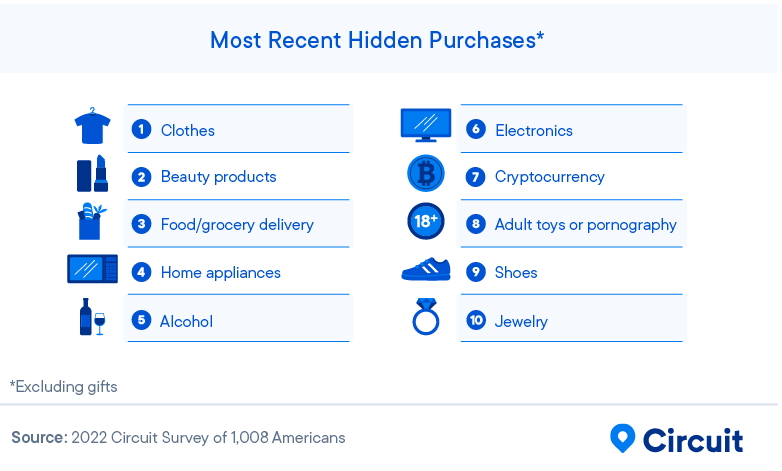
Besides hiding cryptocurrency purchases, the survey found that American partners also fail to disclose about nine other secret acquisitions. These acquisitions range from adult toys and pornography to food and grocery delivery.
American Financial Infidelity Report: 2 out of 5 Survey Respondents Hid Their Crypto Purchases

The Consequences of Lying

Although respondents have their reasons for choosing to make the purchases secret, the blog post warns that lying about money matters “can lead to distrust, debt, fights and relationship trouble.” Therefore, to minimize the risk of getting caught, Americans are said to employ different tactics to stop keep their secret purchases from being discovered.

One such tactic that was apparently used by 38.9% of respondents to prevent a partner from discovering a secret purchase is the opening of a secret credit card. In other instances, the respondents said they would request the delivery service to hide the purchase. According to the study findings, about 41.1% of men had asked the delivery service to hide a purchase, compared to 34% of women that did the same.

On the other hand, the survey found that 1 in 3 women have intercepted a driver right before a delivery is made. Only 1 in 4 men admitted to doing the same.

According to the survey findings, the most effective method used by Americans to hide purchases is the clearing of browsing history. About 45.7% of the respondents admitted to using this method. Special delivery requests are the next most effective method used by cheating partners.

What are your thoughts on this story? Tell us what you think in the comments section below.


from Bitcoin News https://ift.tt/Y7VjKEw

Comments

Popular posts from this blog

Mt Gox Creditors Updated, Trustee Says Rehabilitation Custodian Is ‘Currently Preparing to Make Repayments’

On August 31, 2022, the Mt Gox trustee Nobuaki Kobayashi explained in a recent letter that the rehabilitation custodian is “currently preparing to make repayments” to Mt Gox creditors. Trustee Updates Mt Gox Creditors — Repayment Date and Exchange Still Unknown Last week speculation and rumors concerning the release of 140K bitcoin ( BTC ) from Mt Gox littered social media platforms and headlines. Bitcoin.com News covered the situation six days ago as a number of people and Mt Gox creditors called the rumors “ fake news .” During that same period of time, a bitcoin whale transferred 10,000 BTC to unknown wallets, and a 2018 annotation , heuristics, and clustering methods show the funds likely originated from the June 2011 Mt Gox hacks. Following the mysterious whale transfer, last Wednesday, Mt Gox published an official update from the court trustee Nobuaki Kobayashi that explains the court is “currently preparing to make repayments” to creditors. Mt Gox creditors have been wait...

Fidelity Discusses Bitcoin as Portfolio Insurance — Could Soon Stand in ‘Stark Contrast’ to Path Fiat Currencies Take

Fidelity Digital Assets, a subsidiary of Fidelity Investments, says that bitcoin could be considered portfolio insurance. The firm notes that the cryptocurrency “may soon stand in stark contrast to the path that the rest of the world and fiat currencies may take — namely the path of increased supply, additional currency creation, and central bank balance sheet expansion.” Fidelity Says Bitcoin Could Be Portfolio Insurance Fidelity Digital Assets, a subsidiary of Fidelity Investments, recently published a research study titled “The Rising Dollar and Bitcoin.” The research outlines “how bitcoin could be considered portfolio insurance” as the rising dollar impacts global currency markets. “The strengthening U.S. dollar is wreaking havoc among other countries and may put pressure on the Federal Reserve to soon reverse its tightening monetary actions, something that has precedent based on 1985’s Plaza Accord,” Fidelity explained. In addition, “more monetary debasement may be needed to ...

Economists Discuss Russia, China Potentially Developing Gold-Backed Currency That Could Undermine US Dollar

Economists have weighed in on reports that China and Russia may be developing a new gold-backed currency that could undermine the U.S. dollar’s status as the world’s primary reserve currency. Russia and China May Be Developing Gold-Backed Currency Several experts have shared their views on Russia and China potentially creating a new gold-baked currency, Fox Business reported Saturday, emphasizing that China has been buying up huge quantities of gold while Russia was forced off the U.S. dollar due to sanctions imposed on the country following its invasion of Ukraine. The news outlet noted that some experts have cautioned that these moves, along with the closer relationship that has developed between Moscow and Beijing, point to the likelihood of China attempting to launch a gold-backed currency. However, neither Russia nor China has officially confirmed plans for such a currency. Craig Singleton, senior fellow at the Foundation for Defense of Democracies and a former U.S. diplomat,...