
Poly Network Says Stolen User Assets on ETH Have Been Returned, Except Frozen USDT

Poly Network Says Stolen User Assets on ETH Have Been Returned, Except Frozen USDT

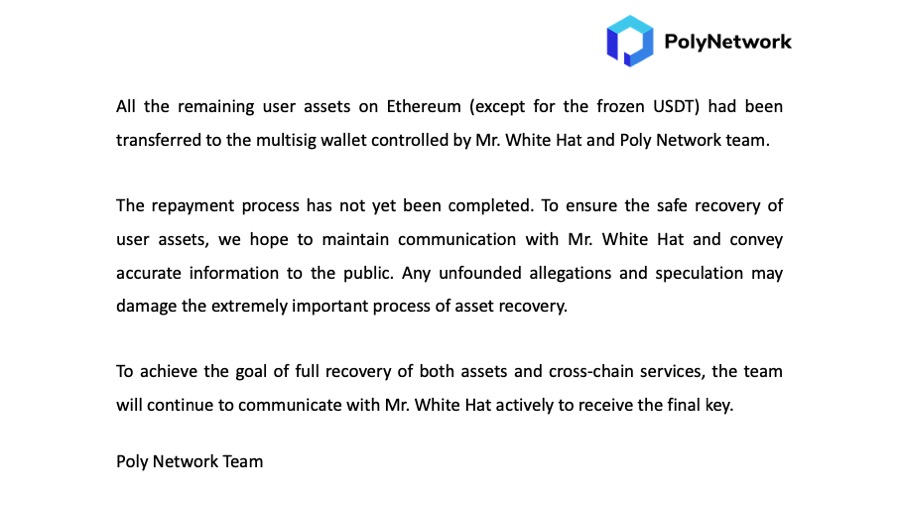
On Friday, a few days after the initial hack for $611 million, the Poly Network project detailed that the company has obtained all the assets stolen minus the frozen tether that was blacklisted by Tether Limited. The Poly Network team said they are in control of the funds along with “Mr. White Hat,” but the repayment process is not complete.

Poly Network Hacker Returns Most of the Stolen Crypto Assets

  • According to a message from the Poly Network team, a large majority of the stolen funds from the August 10 hack have been returned. The stash of tether (USDT) are the only funds that remain in limbo according to a recent letter from the Poly Network team.
  • The Poly Network hacker stole ​​$611 million worth of ETH, WETH, WBTC, UNI, RENBTC, USDT, USDC, DAI, SHIB, FEI, BNB, and various BEP-20 tokens. All have been returned except the frozen the USDT which equals roughly $33 million in tethers.
  • The Poly Network protocol is a cross-chain service that stems from the NEO blockchain project. Poly Network leverages a few different blockchains including Polygon, Ethereum, and the Binance Smart Chain (BSC).
  • The hacker and Mr. White Hat communicated with the team for three days, and there’s actually a confession stemming from a Q&A session with Mr. White Hat and the hacker. A lot of people assumed the hacker was exposed by leaving a fingerprint on the relatively unknown crypto exchange Hoo.com.
  • The hacker’s confession details that the individual does not believe they were exposed. When asked if they were exposed, the hacker replied: “No. never. I understood the risk of exposing myself even if I don’t do evil. So I used temporary email, IP or so-called fingerprint, which were untraceable. I prefer to stay in the dark and save the world.”
  • The hacker said again that it could have been worse and that the individual chose to ignore the “sh**coins.” “Believe it or not, I was forced to play the game,” the hacker confessed. “However, I didn’t want to cause real panic [in the] crypto world. so I chose to ignore sh**coins, so people didn’t have to worry about them going to zero. I took important tokens (except for SHIB) and didn’t sell any of them.”
  • Whatever the case may be, the hacker was able to accomplish the largest attack on a decentralized finance (defi) project since the inception of defi. It’s hard to say when Poly Network will get everyone reimbursed but receiving a great majority of the stolen funds likely saved the project.
  • “I would like to give them tips on how to secure their networks, so that they can be eligible to manage [a billion-dollar] project in the future,” the hacker’s confession added.

What do you think about the Poly Network hacker’s confession and how they returned most of the stolen crypto coins? Let us know what you think about this subject in the comments section below.


from Bitcoin News https://ift.tt/3iJvied

Comments

Popular posts from this blog

Mt Gox Creditors Updated, Trustee Says Rehabilitation Custodian Is ‘Currently Preparing to Make Repayments’

On August 31, 2022, the Mt Gox trustee Nobuaki Kobayashi explained in a recent letter that the rehabilitation custodian is “currently preparing to make repayments” to Mt Gox creditors. Trustee Updates Mt Gox Creditors — Repayment Date and Exchange Still Unknown Last week speculation and rumors concerning the release of 140K bitcoin ( BTC ) from Mt Gox littered social media platforms and headlines. Bitcoin.com News covered the situation six days ago as a number of people and Mt Gox creditors called the rumors “ fake news .” During that same period of time, a bitcoin whale transferred 10,000 BTC to unknown wallets, and a 2018 annotation , heuristics, and clustering methods show the funds likely originated from the June 2011 Mt Gox hacks. Following the mysterious whale transfer, last Wednesday, Mt Gox published an official update from the court trustee Nobuaki Kobayashi that explains the court is “currently preparing to make repayments” to creditors. Mt Gox creditors have been wait...

Fidelity Discusses Bitcoin as Portfolio Insurance — Could Soon Stand in ‘Stark Contrast’ to Path Fiat Currencies Take

Fidelity Digital Assets, a subsidiary of Fidelity Investments, says that bitcoin could be considered portfolio insurance. The firm notes that the cryptocurrency “may soon stand in stark contrast to the path that the rest of the world and fiat currencies may take — namely the path of increased supply, additional currency creation, and central bank balance sheet expansion.” Fidelity Says Bitcoin Could Be Portfolio Insurance Fidelity Digital Assets, a subsidiary of Fidelity Investments, recently published a research study titled “The Rising Dollar and Bitcoin.” The research outlines “how bitcoin could be considered portfolio insurance” as the rising dollar impacts global currency markets. “The strengthening U.S. dollar is wreaking havoc among other countries and may put pressure on the Federal Reserve to soon reverse its tightening monetary actions, something that has precedent based on 1985’s Plaza Accord,” Fidelity explained. In addition, “more monetary debasement may be needed to ...

Economists Discuss Russia, China Potentially Developing Gold-Backed Currency That Could Undermine US Dollar

Economists have weighed in on reports that China and Russia may be developing a new gold-backed currency that could undermine the U.S. dollar’s status as the world’s primary reserve currency. Russia and China May Be Developing Gold-Backed Currency Several experts have shared their views on Russia and China potentially creating a new gold-baked currency, Fox Business reported Saturday, emphasizing that China has been buying up huge quantities of gold while Russia was forced off the U.S. dollar due to sanctions imposed on the country following its invasion of Ukraine. The news outlet noted that some experts have cautioned that these moves, along with the closer relationship that has developed between Moscow and Beijing, point to the likelihood of China attempting to launch a gold-backed currency. However, neither Russia nor China has officially confirmed plans for such a currency. Craig Singleton, senior fellow at the Foundation for Defense of Democracies and a former U.S. diplomat,...