
FTC Warns of Romance Scams Luring People Into Bogus Cryptocurrency Investments

FTC Warns of Romance Scams Luring People Into Bogus Cryptocurrency Investments

The U.S. Federal Trade Commission (FTC) has warned about romance scams using cryptocurrency. Scammers use romance as a hook to lure people into bogus investments, especially crypto, the federal agency explained. “2021 numbers are nearly five times those reported in 2020, and more than 25 times those reported in 2019,” said the FTC.

FTC Warns About Crypto Romance Scams

The U.S. Federal Trade Commission (FTC) issued a warning Thursday about crypto-related romance scams. The FTC is an independent agency of the U.S. government whose principal mission is the enforcement of civil U.S. antitrust law and the promotion of consumer protection.

“New data from the Federal Trade Commission show that more consumers than ever report falling prey to romance scammers. Consumers reported losing $547 million in 2021 alone,” the FTC wrote, adding:

A growing trend in 2021 was scammers using romance as a hook to lure people into bogus investments, especially cryptocurrency.

“Consumers who paid romance scammers with cryptocurrency reported losing $139 million in total in 2021, more than any other payment amount,” the federal agency detailed. “2021 numbers are nearly five times those reported in 2020, and more than 25 times those reported in 2019.”

In addition, the FTC noted that the median loss for consumers who reported paying a romance scammer with cryptocurrency in 2021 was nearly $9,770.
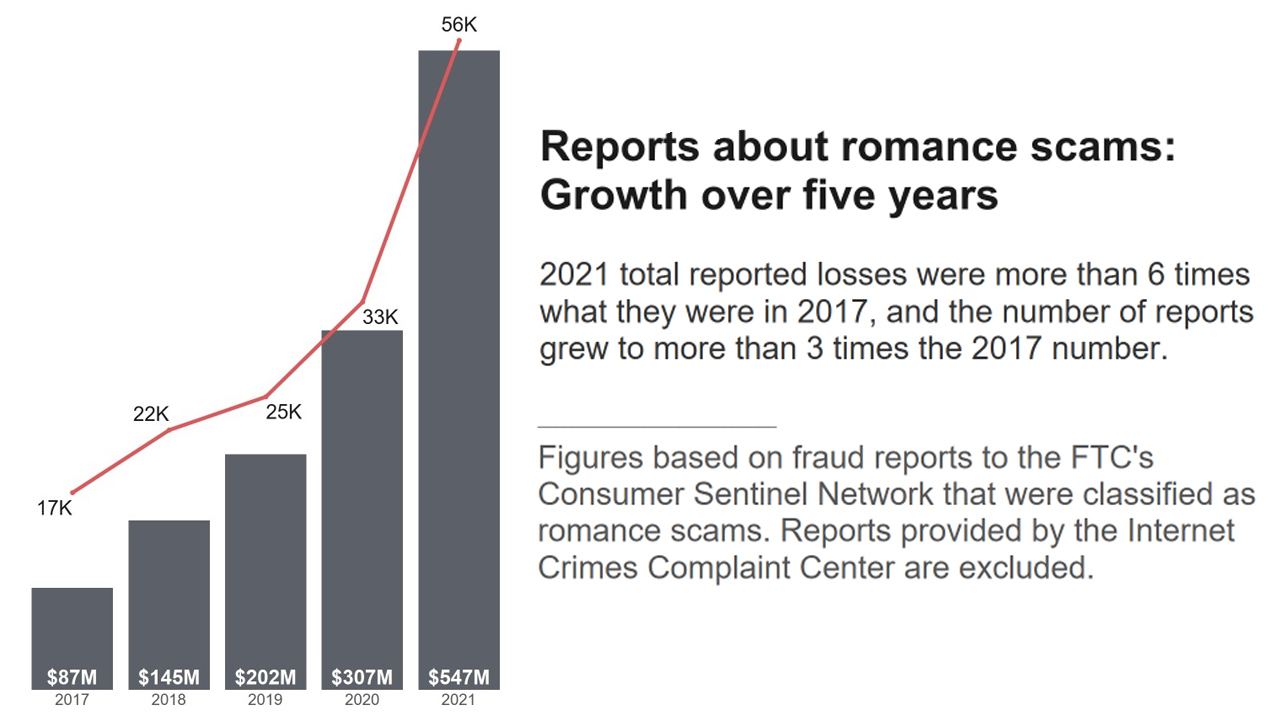
The Federal Trade Commission explained that in romance scams:

People are led to believe their new online companion is a successful investor who, before long, casually offers investment advice.

Besides cryptocurrency, another popular investment method promoted by these romance scammers involves foreign exchange (forex) trading.

However, the most common method of payment to romance scammers is not cryptocurrency. “About 28% of people who reported losing money on a romance scam in 2021 said they paid with a gift card or reload card, followed by cryptocurrency (18%),” the FTC clarified.

The federal agency has issued several warnings about scams involving cryptocurrency this year. In January, it warned about crypto scams using social media and ATMs.

What do you think about crypto romance scams? Let us know in the comments section below.


from Bitcoin News https://ift.tt/7fpHmMw

Comments

Popular posts from this blog

Mt Gox Creditors Updated, Trustee Says Rehabilitation Custodian Is ‘Currently Preparing to Make Repayments’

On August 31, 2022, the Mt Gox trustee Nobuaki Kobayashi explained in a recent letter that the rehabilitation custodian is “currently preparing to make repayments” to Mt Gox creditors. Trustee Updates Mt Gox Creditors — Repayment Date and Exchange Still Unknown Last week speculation and rumors concerning the release of 140K bitcoin ( BTC ) from Mt Gox littered social media platforms and headlines. Bitcoin.com News covered the situation six days ago as a number of people and Mt Gox creditors called the rumors “ fake news .” During that same period of time, a bitcoin whale transferred 10,000 BTC to unknown wallets, and a 2018 annotation , heuristics, and clustering methods show the funds likely originated from the June 2011 Mt Gox hacks. Following the mysterious whale transfer, last Wednesday, Mt Gox published an official update from the court trustee Nobuaki Kobayashi that explains the court is “currently preparing to make repayments” to creditors. Mt Gox creditors have been wait...

Economists Discuss Russia, China Potentially Developing Gold-Backed Currency That Could Undermine US Dollar

Economists have weighed in on reports that China and Russia may be developing a new gold-backed currency that could undermine the U.S. dollar’s status as the world’s primary reserve currency. Russia and China May Be Developing Gold-Backed Currency Several experts have shared their views on Russia and China potentially creating a new gold-baked currency, Fox Business reported Saturday, emphasizing that China has been buying up huge quantities of gold while Russia was forced off the U.S. dollar due to sanctions imposed on the country following its invasion of Ukraine. The news outlet noted that some experts have cautioned that these moves, along with the closer relationship that has developed between Moscow and Beijing, point to the likelihood of China attempting to launch a gold-backed currency. However, neither Russia nor China has officially confirmed plans for such a currency. Craig Singleton, senior fellow at the Foundation for Defense of Democracies and a former U.S. diplomat,...

Fidelity Discusses Bitcoin as Portfolio Insurance — Could Soon Stand in ‘Stark Contrast’ to Path Fiat Currencies Take

Fidelity Digital Assets, a subsidiary of Fidelity Investments, says that bitcoin could be considered portfolio insurance. The firm notes that the cryptocurrency “may soon stand in stark contrast to the path that the rest of the world and fiat currencies may take — namely the path of increased supply, additional currency creation, and central bank balance sheet expansion.” Fidelity Says Bitcoin Could Be Portfolio Insurance Fidelity Digital Assets, a subsidiary of Fidelity Investments, recently published a research study titled “The Rising Dollar and Bitcoin.” The research outlines “how bitcoin could be considered portfolio insurance” as the rising dollar impacts global currency markets. “The strengthening U.S. dollar is wreaking havoc among other countries and may put pressure on the Federal Reserve to soon reverse its tightening monetary actions, something that has precedent based on 1985’s Plaza Accord,” Fidelity explained. In addition, “more monetary debasement may be needed to ...