Economists Say Fed Could Shrink Balance Sheet in 2023, Critics Insist Central Bank Hasn’t Reduced QE at All
With inflation soaring in the U.S., economists from monetary policy analytics and forecasting firm LH Meyer say the U.S. Federal Reserve could stop shrinking its balance sheet earlier than expected. However, critics have said the U.S. central bank hasn’t really shrunk the Fed’s balance at all, and the entity has been accused of keeping quantitative easing (QE) practices persistent by continuing to purchase long-term securities from the market.
Forecasting Firm LH Meyer Predicts Fed Will Shrink the Balance Sheet Earlier Than Expected, While the Central Bank’s Reductions Remain Contested
U.S. monetary policymakers are up in arms over the economy’s inflationary pressures and the current debate over the technical definition of a recession. Analysts suspect the Federal Reserve will increase the federal funds rate by at least 75 to upwards of 100 basis points (bps) at the next meeting.
In addition to the rate hikes, the Fed said last year that it would reduce the $8.5 trillion balance sheet by June 1. The central bank said at the time it would slowly stop purchasing mortgage-backed securities (MBS) and maturing Treasuries.
As the war continues in Ukraine and inflation rose at the highest pace in over 40 years last month, many economists believe the U.S. central bank has a lot of work to do when it comes to monetary tightening practices. The former economic adviser to ex-president Barack Obama, Larry Summers, recently mentioned the Fed has an issue to deal with.
When speaking about a recession, Summers insisted that things will depend on “how skillful the [Federal Reserve] turns out to be… They’ve got a very, very difficult problem of balance in setting monetary policy, given the situation in which we find ourselves.”
The latest U.S. Consumer Price Index (CPI) report had shown that June reflected a 9.1% year-over-year increase. The inflation has caused a number of people to suspect the Fed will be dovish on the next two federal fund rate hikes and possibly halt the central bank’s QE reduction.
However, the Fed’s balance sheet reduction that was supposed to start in June has been contested, and many observers think the Fed has continued QE. On the other hand, economists from the forecasting firm LH Meyer say the Fed’s reduction “may stop early as recession risk rises,” according to a report published by the Wall Street Journal (WSJ).
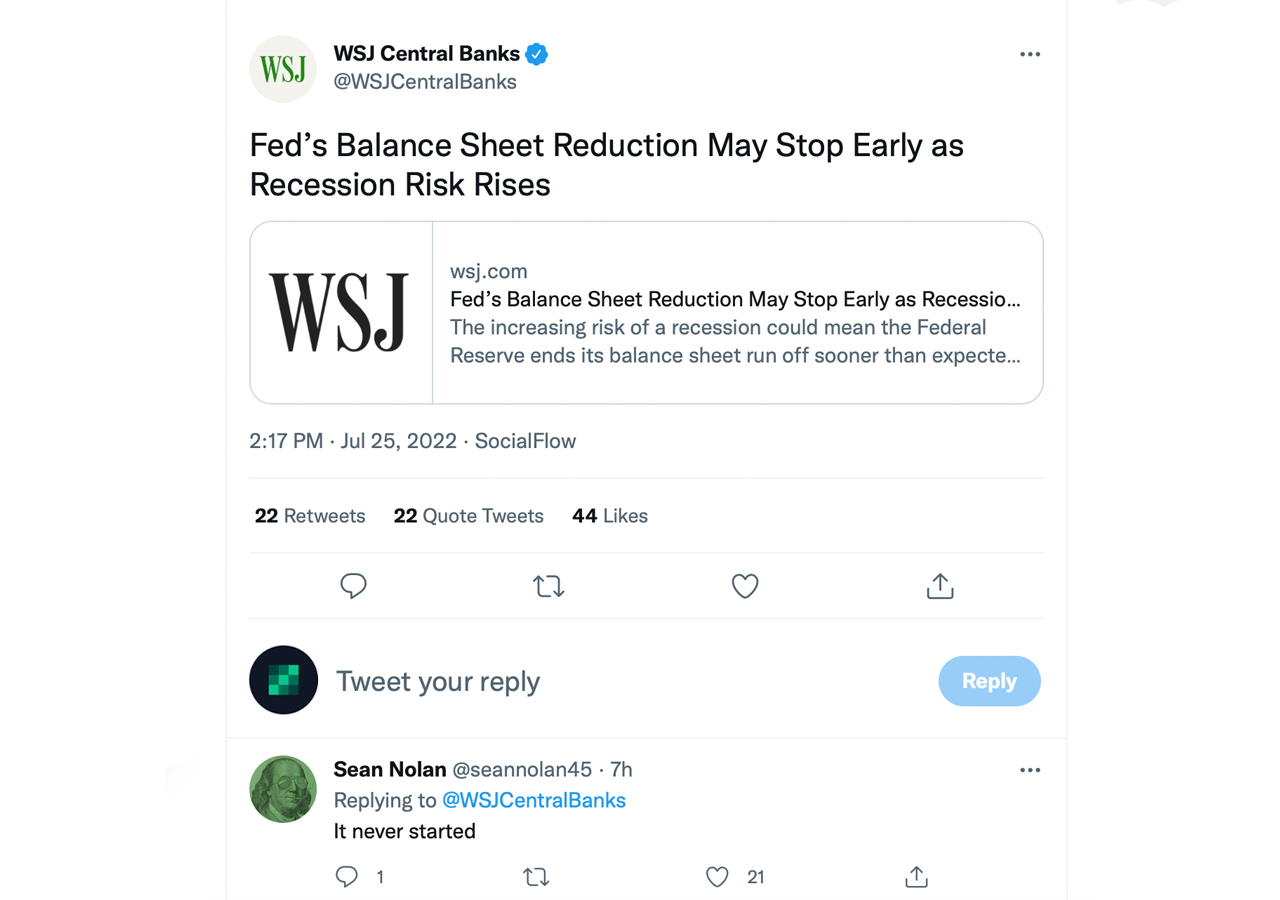
The WSJ article details that recession risk may make the Fed stop shrinking its balance sheet “sooner than expected,” according to the LH Meyer economists. The researchers at the firm predict a recession is likely to take place in 2024. Furthermore, the report explains that it’s possible the U.S. central bank could halt quantitative tightening (QT) by next year.
When the WSJ shared the editorial via Twitter many criticized the entire report, because they don’t believe the Fed has reduced its balance sheet. “It never started,” one individual wrote. “Balance sheet keeps growing, there was no reduction,” another person replied.
Critics Claim Fed’s QE Programs Are Fully Operational
At the end of June, the gold bug and economist Peter Schiff denounced the U.S. central bank for continuing the QE process. “The Fed’s balance sheet just expanded for the third week in a row in June,” Schiff said. “The rise of $1.9 billion increased the size of the Fed’s balance sheet to $8.934 trillion. I wonder when the Fed will stop creating inflation by ending QE and actually start fighting it by beginning QT.”
On July 15, the author and market maniac at Welt, Holger Zschaepitz, said the Fed “has already stopped the shrinking of the balance sheet.” Zschaepitz added:
Total assets grew by $4bn the past week to $8.896tn. Fed balance sheet now equal to 36.5% of [the] U.S.’s GDP vs ECB’s 81.9% and BoJ’s 135%.
The Twitter account called Occupy the Fed Movement spoke about the Fed continuing QE the day before Zschaepitz’s tweet. “FED BS Update: FED increases balance sheet by $4BN ($3.3BN “other assets”) the same week that CPI prints 9.1%,” Occupy the Fed wrote. “USTs up $1.1BN and MBS flat despite supposed QT plans. FED is clearly serious about fighting inflation,” the Twitter account sarcastically added.
For years now the Federal Reserve has been accused of bailing out the mega banks and creating unnatural booms and busts in the American and global economies. Since 2020, the Fed’s balance sheet is significantly larger than any time in history, and the monetary supply growth since that year is pretty hard to fathom.
What do you think about the recent WSJ report that says the Fed could halt the shrinking of its balance sheet? What do you think about the accusations that say the U.S. central bank hasn’t shrunk the balance sheet much at all? Let us know what you think about this subject in the comments section below.
from Bitcoin News https://ift.tt/1robNyR
Comments
Post a Comment