
Ordinals Inscriptions on Bitcoin Surpass 10 Million, Fueling NFT and Token Boom

Ordinals Inscriptions on Bitcoin Surpass 10 Million, Fueling NFT and Token Boom

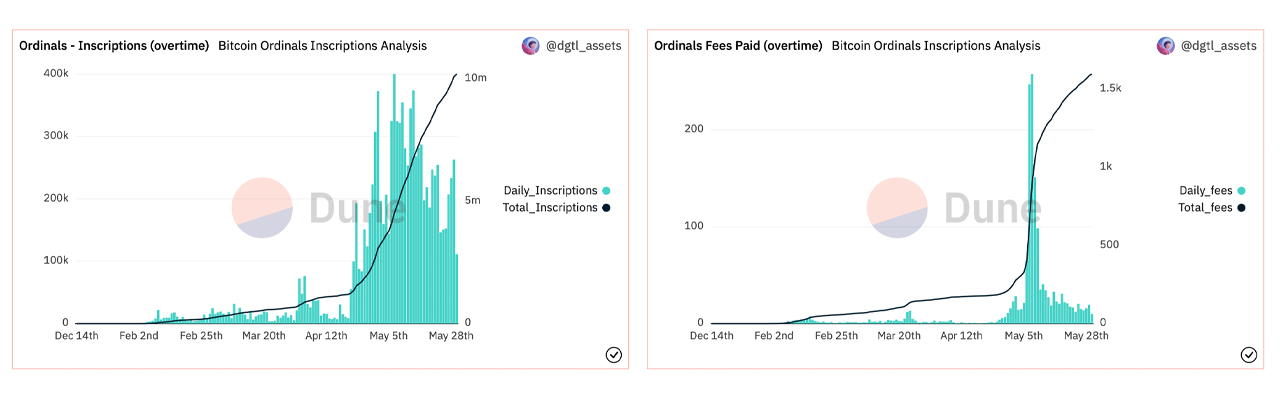
On Monday, May 28, 2023, a pivotal landmark was reached as the aggregate quantity of Ordinal inscriptions minted on the Bitcoin blockchain exceeded 10 million in under half a year. Since Ordinal inscriptions’ inception, bitcoin miners have garnered roughly 1,596 bitcoins, valued at $44.37 million.

10 Million Ordinal Inscriptions and Counting

This week witnessed the total Ordinal inscriptions surpassing the 10 million mark; as of this writing, 10,142,233 inscriptions have been issued. Moreover, the BRC20 token economy consisting of 24,677 registered BRC20 tokens boasts a combined value of $433 million. Bitcoin inscriptions have carved out a niche in the realm of non-fungible token (NFT) markets and currently stand as the second-largest blockchain in terms of NFT sales.

Data from the past 30 days reveals that $190 million worth of Bitcoin-based NFTs have been traded, with the most significant sale being a Space Pepe sold for $4.56 million. Having amassed over 10 million inscriptions, bitcoin miners have obtained supplementary fees equivalent to 1,596 bitcoins or $44.37 million since December 2022. In marketplaces focused on Ordinals, 347,129 transactions have been documented, generating $176.46 million in trade volume.
Ordinals Inscriptions on Bitcoin Surpass 10 Million, Fueling NFT and Token Boom

Among Ordinals and BRC20 marketplaces are Ordinals Market, Ordswap, Ordinals Wallet, Open Ordex, Gamma, Magic Eden, and Unisat. Recently, Ordinals Market collaborated with Bitcoin Miladys on a project to bridge BRC20s with Ethereum’s ERC721 tokens. Notably, just days before Ordinal inscriptions hit the 10-million mark, Casey Rodarmor — creator of the Ordinals inscription technology — resigned as the codebase’s chief maintainer.

Rodarmor transferred control of the project to an enigmatic software developer known as Raphjaph. Of the 10 million Bitcoin-based inscriptions hosted on the chain, 91% or 9.2 million feature plain text inscriptions. Over 775,000 Ordinal inscriptions comprise image files like PNGs or JPEGs, while the remainder of inscriptions on Bitcoin consist of videos, applications, and audio recordings.

Although Ordinals have gained popularity, several bitcoiners and cryptocurrency influencers have expressed disapproval. Some argue that Ordinal inscriptions contribute to a considerable backlog of transactions and elevated onchain fees for network activities. Detractors have labeled the inscriptions trend an “attack” and “spam,” asserting that financial transactions should be the sole transfers on the Bitcoin blockchain.

What are your thoughts on the rapid growth of Ordinal inscriptions on the Bitcoin blockchain and their impact on the NFT market? Share your insights and opinions in the comments section below.


from Bitcoin News https://ift.tt/HvhI87x

Comments

Popular posts from this blog

Mt Gox Creditors Updated, Trustee Says Rehabilitation Custodian Is ‘Currently Preparing to Make Repayments’

On August 31, 2022, the Mt Gox trustee Nobuaki Kobayashi explained in a recent letter that the rehabilitation custodian is “currently preparing to make repayments” to Mt Gox creditors. Trustee Updates Mt Gox Creditors — Repayment Date and Exchange Still Unknown Last week speculation and rumors concerning the release of 140K bitcoin ( BTC ) from Mt Gox littered social media platforms and headlines. Bitcoin.com News covered the situation six days ago as a number of people and Mt Gox creditors called the rumors “ fake news .” During that same period of time, a bitcoin whale transferred 10,000 BTC to unknown wallets, and a 2018 annotation , heuristics, and clustering methods show the funds likely originated from the June 2011 Mt Gox hacks. Following the mysterious whale transfer, last Wednesday, Mt Gox published an official update from the court trustee Nobuaki Kobayashi that explains the court is “currently preparing to make repayments” to creditors. Mt Gox creditors have been wait...

DefiDollar Listing on AscendEX

PRESS RELEASE. AscendEX, formerly BitMax, an industry-leading digital asset trading platform built by Wall Street quant trading veterans, has announced the listing of the DefiDollar Token (DFD) under the pair USDT/DFD on Apr 29 at 1:00 p.m. UTC. DefiDollar is a DeFi lab that aims to bring mass adoption to DeFi with a wide-ranging product suite. The first product offering to go live will be the stablecoin index – DUSD, with ibBTC and optionCoin currently in development. DefiDollar (DUSD) aspires to be a risk-insured stablecoin layer for DeFi. It is designed to provide a safe and stable way for users to hold their assets with DUSD being optimized for peg safety, yield, and diversification. DefiDollar uses DeFi primitives to stay close to the dollar mark. DUSD provides an avenue for diversifying stablecoin holdings to hedge against an event where the underlying stablecoins like Tether or DAI deviate from their peg. DUSD is collateralized by Curve Finance LP tokens. DFD is the n...

International Crypto Exchange Luno Adds Bitcoin Cash Trading

Luno exchange has added bitcoin cash trading to the platform following feedback from its client base. BCH is now only the third cryptocurrency available for trading on the exchange, in addition to BTC and ETH , but more options could be on the way once Luno determines that they are credible enough. Also Read: Bitflyer Adds Bitcoin Cash Trading Across Europe and the US Luno Adds Bitcoin Cash Trading Luno, the London-headquartered company formerly known as Bitx, recently announced that bitcoin cash was made available on its cryptocurrency exchange. Starting from Monday, September 23, customers at Luno are now able to store, buy and sell BCH on the platform. The reason given for adding BCH to the exchange is feedback from users in developing markets that convinced Luno to expand their offering from previously just BTC and ETH . Marcus Swanepoel, CEO of Luno, said , “We are in a new and exciting financial era. Developing economies are leading the large-scale adoption and appli...