
For a couple of years now, MEV-Boost relays or Flashbots have become popular tools in order to gather the maximum value that can be extracted from Ethereum’s block production. However, in recent times, Flashbots have been controversial as people believe the technology threatens Ethereum’s censorship-resistance. This is because Flashbots account for 48% of blocks that are compliant with government-enforced regulations.
Nakamoto Coefficient or Government Coefficient? — Crypto Users Complain That OFAC-Compliant Flashbots Have Stained Ethereum’s Censorship-Resistance
While Ethereum has been complimented for meeting the demands of environmentalists, critics believe the blockchain network made a trade-off by increasing validator centralization, and the probability of rising censorship for a so-called ‘greener’ blockchain. The day after The Merge, when Ethereum transitioned from a proof-of-work (PoW) network to a proof-of-stake (PoS) blockchain, PoW supporters criticized Ethereum over the increased possibility of validator censorship. Data had shown that more than 59% of all the staked ethereum (ETH) was held by four companies.
I have never been more excited about the future of Flashbots. https://t.co/hSgI2XMFDG
— @bertcmiller ⚡️🤖 (@bertcmiller) October 14, 2022
Although, some people dismissed the critics, like the Bitcoin supporter and blogger Eric Wall, who told his Twitter followers that the liquid staking company “Lido isn’t even a pool.” Wall further noted that “Lido can’t decide what blocks anyone of their underlying node operators mine.” Following the topic of increasing validator centralization, another discussion concerning the use of Flashbots or MEV-Boost relays has heightened. Flashbots emerged in November 2020, and researchers from Bitmex describe what MEV-Boost relay technology does in a Flashbots report published last May.
“Flashbots works as follows — Searchers analyse the blockchain and memory pool for MEV opportunities,” the Bitmex report on Flashbots explains. “When they find such an opportunity they create a transaction or bundle of transactions which exploits it. They then submit these transactions to the centralised Flashbots server. These transactions also include a payment for the miners. The idea here is that a searcher will no longer bother broadcasting their MEV transactions to the memory pool anymore and will only use the Flashbots system.”
Close to Half of Ethereum’s Daily Blocks Are OFAC-Compliant Blocks
The conversation concerning Flashbots isn’t really about the technology of finding the maximum value that can be extracted from Ethereum’s block production, as the discussion has been solely based on transaction censorship stemming from MEV-Boost relays. For instance, after the U.S. Treasury Department’s watchdog the Office of Foreign Asset Control (OFAC) banned Tornado Cash and several ethereum addresses, crypto supporters believe Flashbots will censors ether transactions. That’s because some MEV-Boost relays or Flashbots are centralized and are regulated under OFAC rules.
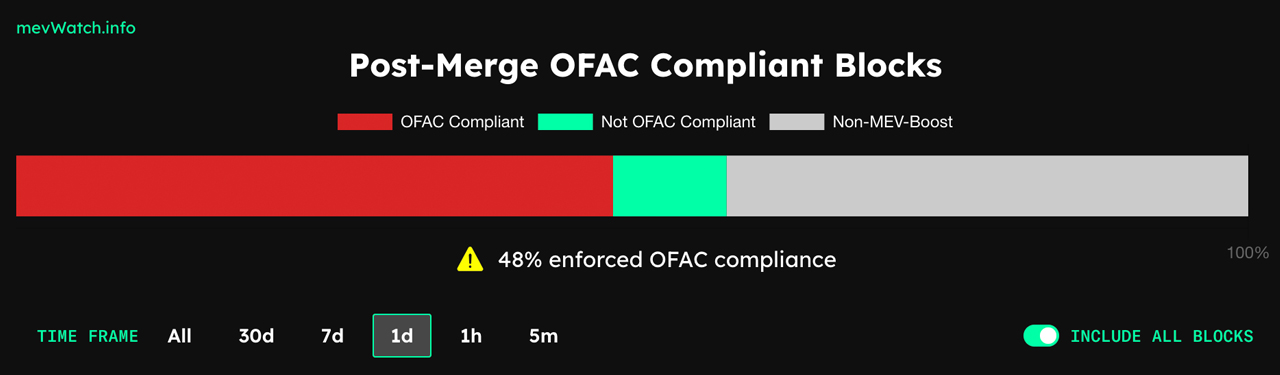
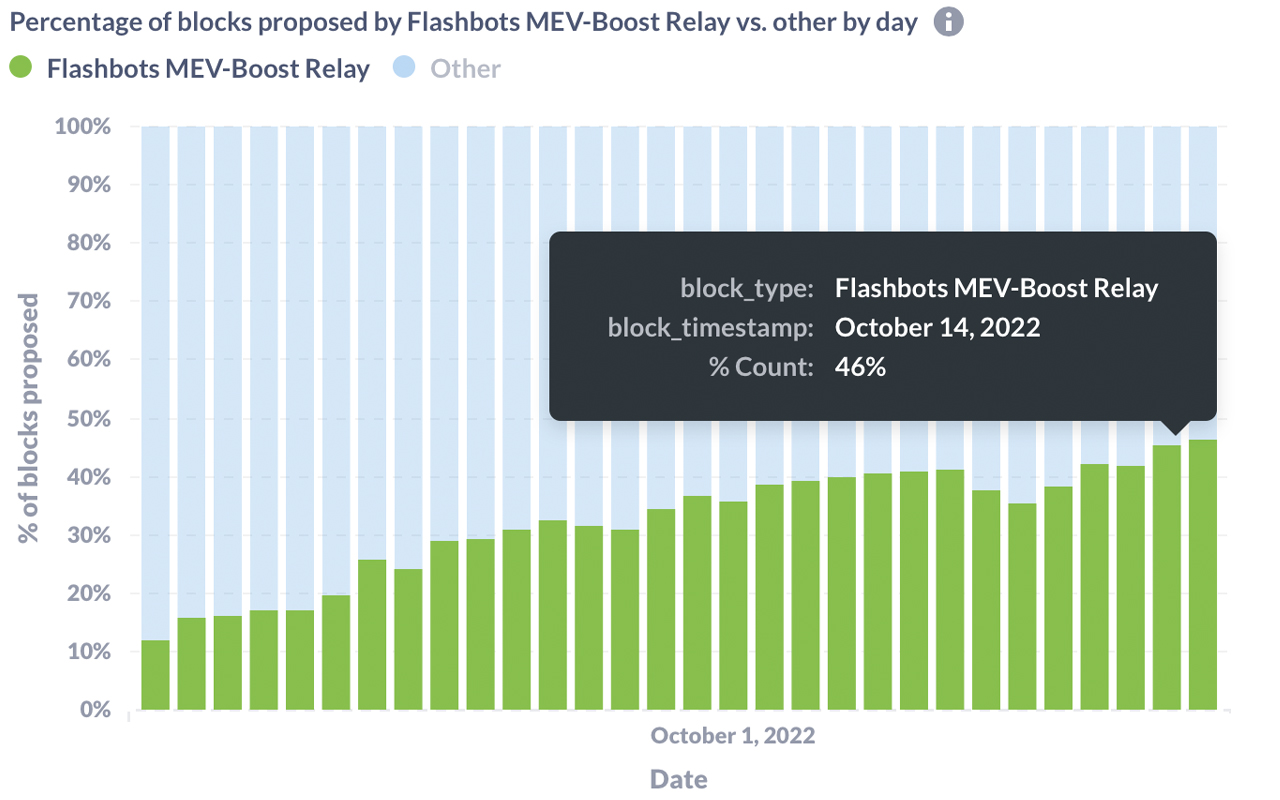
At the time of writing, 48% of block production has been enforced by OFAC complaint MEV-Boost relays, according to mevwatch.info statistics. Metrics from flashbots.net’s transparency page show that 46% of blocks on October 14, were OFAC compliant.
Martin Köppelmann, the co-founder of Gnosis, tweeted about the issue when the OFAC-compliant block production was above 51%. “We reached another sad milestone in censorship: 51%,” Köppelmann wrote. “This means if the censoring validators would now stop attesting to non-censoring blocks they would eventually form the canonical, 100% censoring chain.”
The Gnosis co-founder added:
Dear Flashbots team – I spoke to many of you personally and you committed to take actions if censorship becomes worse – but if not now, when then?
Flashbots Team Pledges to Fight Censorship, Introduces a New Tool Called SUAVE
According to the Flashbots team and product head Robert Miller, Flashbots is working on a solution to address censorship concerns with a tool called SUAVE. The SUAVE tool is set to be released next week, according to insiders. Furthermore, Flashbots co-founder Stephane Gosselin left the project over disagreements regarding the ethics behind censorship. Speaking exclusively with the theblock.co’s contributor Jeremy Nation, Gosselin told the reporter that censorship resistance is very important.
“In the short term, I am hopeful that validators will avoid connecting to relays that perform censorship,” Gosselin told the publication in a direct message on Twitter. “Blockspace suppliers putting economic pressure against censorship will go a long way to making sure it does not become ubiquitous,” the Flashbots co-founder added. At Devcon VI, the Flashbots team introduced the new SUAVE tool to the audience, and further explained that the project is 100% against censorship.
“[Phil Daian] is stating that he is 100% against censorship and though flashbots does censor today they want to fight censorship and the way to do that is through [open source], research and open data,” the Twitter user Lefteris Karapetsas wrote during Daian’s Devcon VI presentation.
What do you think about the controversy surrounding the MEV-Boost relays or Flashbots technology? Let us know what you think about this subject in the comments section below.
from Bitcoin News https://ift.tt/PE75otr
Comments
Post a Comment