
Latest CPI Data Shows Red-Hot Inflation Continues to Thrive in the US, Consumer Prices Jumped 8.2% in September

Latest CPI Data Shows Red-Hot Inflation Continues to Thrive in the US, Consumer Prices Jumped 8.2% in September

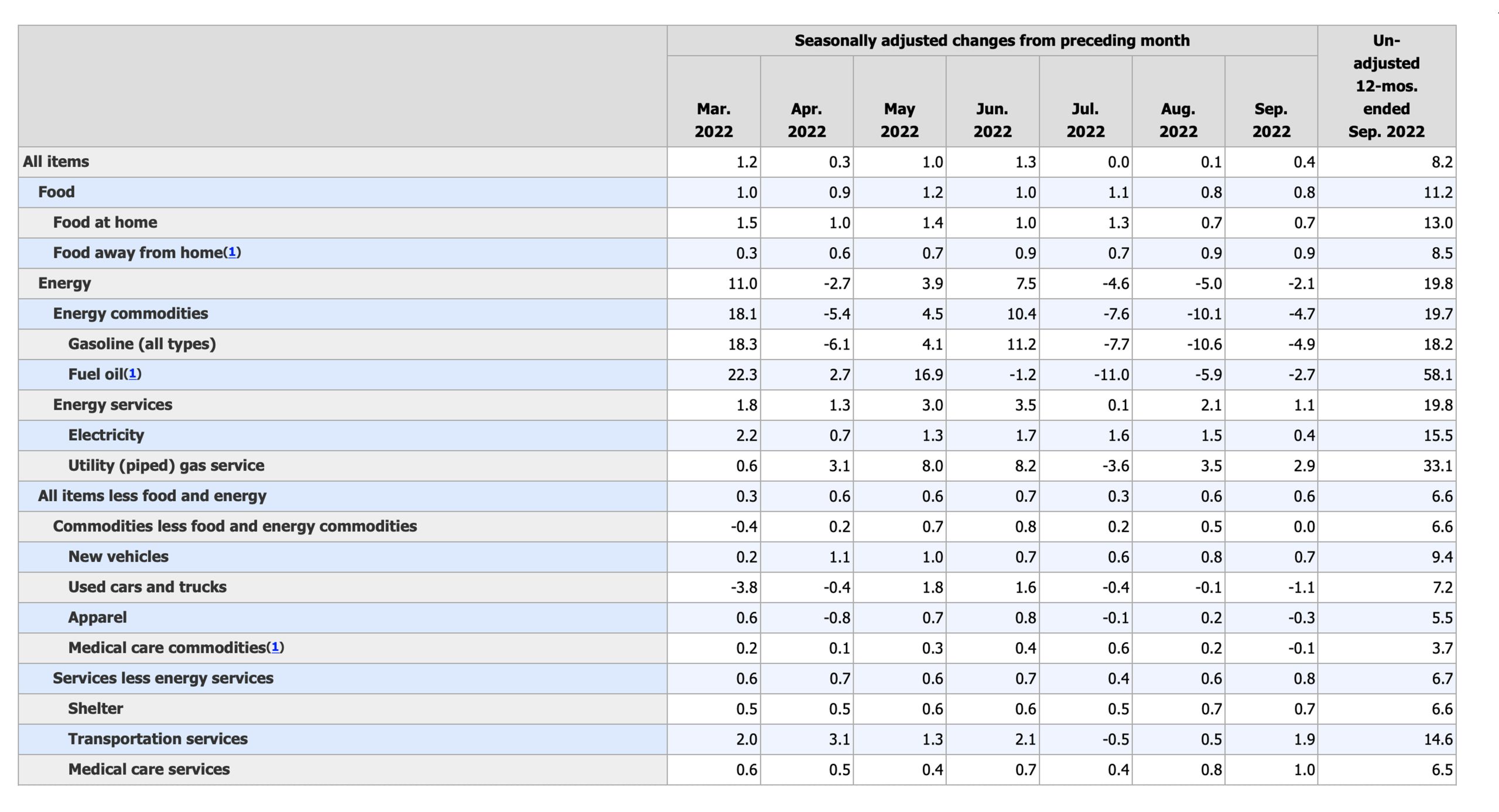
The latest inflation data from the United States indicates that consumer prices have kept climbing despite expectations of a slowdown. The Consumer Price Index (CPI) summary published on Thursday shows an 8.2% rise in the year through September, and the core index rating saw the fastest yearly increase since 1982.

September’s CPI Data Was Worse Than Expected, Report Signals an Aggressive Fed Rate Hike on the Horizon, Global Markets Shudder

U.S. inflation numbers for September are in, and the inflation rate, or CPI, is worse than expected. According to the U.S. Bureau of Labor Statistics’ CPI summary published on October 13, the report shows the “Consumer Price Index for All Urban Consumers (CPI-U) rose 0.4 percent in September on a seasonally adjusted basis after rising 0.1 percent in August.” The Bureau of Labor Statistics’ report adds:

Over the last 12 months, the all items index increased 8.2 percent before seasonal adjustment.
Latest CPI Data Shows Red-Hot Inflation Continues to Thrive in the US, Consumer Prices Jumped 8.2% in September

The latest CPI stats also show that the “index for all items less food and energy rose 0.6 percent in September, as it did in August.” Immediately after the report was published all four major U.S. stock indices dropped significantly against the U.S. dollar with Nasdaq shedding the most losses on Thursday. Crypto markets and precious metals followed the same pattern, led by equity markets by tumbling in value against the greenback after the CPI report was published.

Precious metals like gold and silver also took a hit on Thursday as gold is down 1.37% per troy ounce and silver is down 1.68%. Platinum and palladium have also seen losses between 1.59% and 2.91%. Metrics on Thursday further show that the crypto economy has dealt with heavy losses as well, as the entire market capitalization of all the digital assets in existence has slid under the $900 billion mark.

At the time of writing, the global crypto market cap is roughly $886.38 billion, down close to 4% during the last 24 hours. Of course, the worse-than-expected inflation data from the Bureau of Labor Statistics’ CPI report is making investors believe an aggressive Federal Reserve will hike the federal funds rate by another 75 basis points (bps). According to the Investing.com Twitter account, the “Fed funds futures [is] now pricing [in a] 100% chance of 75 bps Fed rate hike at [the November] meeting following CPI data.”

What do you think about the latest inflation report stemming from the U.S. Bureau of Labor Statistics and the market reaction after it was published? Let us know what you think about this subject in the comments section below.


from Bitcoin News https://ift.tt/PIteOYM

Comments

Popular posts from this blog

Mt Gox Creditors Updated, Trustee Says Rehabilitation Custodian Is ‘Currently Preparing to Make Repayments’

On August 31, 2022, the Mt Gox trustee Nobuaki Kobayashi explained in a recent letter that the rehabilitation custodian is “currently preparing to make repayments” to Mt Gox creditors. Trustee Updates Mt Gox Creditors — Repayment Date and Exchange Still Unknown Last week speculation and rumors concerning the release of 140K bitcoin ( BTC ) from Mt Gox littered social media platforms and headlines. Bitcoin.com News covered the situation six days ago as a number of people and Mt Gox creditors called the rumors “ fake news .” During that same period of time, a bitcoin whale transferred 10,000 BTC to unknown wallets, and a 2018 annotation , heuristics, and clustering methods show the funds likely originated from the June 2011 Mt Gox hacks. Following the mysterious whale transfer, last Wednesday, Mt Gox published an official update from the court trustee Nobuaki Kobayashi that explains the court is “currently preparing to make repayments” to creditors. Mt Gox creditors have been wait...

Economists Discuss Russia, China Potentially Developing Gold-Backed Currency That Could Undermine US Dollar

Economists have weighed in on reports that China and Russia may be developing a new gold-backed currency that could undermine the U.S. dollar’s status as the world’s primary reserve currency. Russia and China May Be Developing Gold-Backed Currency Several experts have shared their views on Russia and China potentially creating a new gold-baked currency, Fox Business reported Saturday, emphasizing that China has been buying up huge quantities of gold while Russia was forced off the U.S. dollar due to sanctions imposed on the country following its invasion of Ukraine. The news outlet noted that some experts have cautioned that these moves, along with the closer relationship that has developed between Moscow and Beijing, point to the likelihood of China attempting to launch a gold-backed currency. However, neither Russia nor China has officially confirmed plans for such a currency. Craig Singleton, senior fellow at the Foundation for Defense of Democracies and a former U.S. diplomat,...

Fidelity Discusses Bitcoin as Portfolio Insurance — Could Soon Stand in ‘Stark Contrast’ to Path Fiat Currencies Take

Fidelity Digital Assets, a subsidiary of Fidelity Investments, says that bitcoin could be considered portfolio insurance. The firm notes that the cryptocurrency “may soon stand in stark contrast to the path that the rest of the world and fiat currencies may take — namely the path of increased supply, additional currency creation, and central bank balance sheet expansion.” Fidelity Says Bitcoin Could Be Portfolio Insurance Fidelity Digital Assets, a subsidiary of Fidelity Investments, recently published a research study titled “The Rising Dollar and Bitcoin.” The research outlines “how bitcoin could be considered portfolio insurance” as the rising dollar impacts global currency markets. “The strengthening U.S. dollar is wreaking havoc among other countries and may put pressure on the Federal Reserve to soon reverse its tightening monetary actions, something that has precedent based on 1985’s Plaza Accord,” Fidelity explained. In addition, “more monetary debasement may be needed to ...