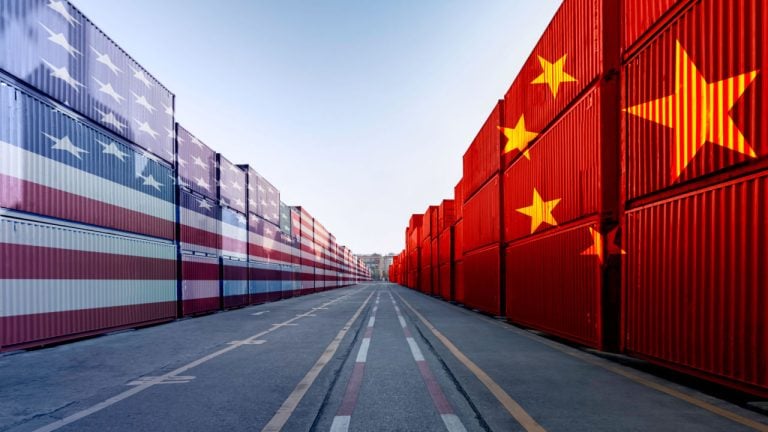
De-Risking or Decoupling? China- US Bilateral Trade Falls More Than 10% This Year

china us trade

Analysts have criticized the new ‘de-risking’ strategy that the U.S. is currently using against China, explained by U.S. National Security Advisor Jake Sullivan in April, clarifying that national security was over economic costs. These de-risking policies might affect bilateral trade, which fell by 11.2% to $217.9 billion during the first four months of 2023.

‘De-Risking’ Is a Euphemism for Decoupling U.S. and China Relations, Analysts State

Analysts are criticizing the ‘de-risking’ strategy of the US against China. The term, which was mentioned by the U.S. National Security Advisor Jake Sullivan last month, is used to explain the position that the U.S. is adopting in front of the growth and policies of China on the Russia-Ukraine conflict. And while U.S. Treasury Secretary Yanet Yellen has previously stated that a full decuple of the economies of the two countries would be “disastrous,” Chinese analysts believe that this is just a semantics choice.

Zhou Xiaoming, a senior researcher at the Centre for China and Globalisation, has stated that this ‘de-risking’ strategy has ‘nothing short’ of decoupling in action, as it seeks to limit the economic interaction with China to just the necessary. Xiaoming explains:

The U.S. will continue to trade with China as it has learned that totally cutting economic ties between the two is neither feasible nor desirable. Nevertheless, the Biden administration still appears intent on building a “small yard” with a “high fence”.

This approach would be responsible for the inclusion of more Chinese companies in the called ‘entity list’ of the Office of Foreign Assets Control (OFAC), and the recent tightening of the export controls on chips to China, but might expand to other fields in the future, Xioaming states.

Possible Effects on Trade

Xiaoming believes that this de-risking strategy seeks to also undermine the relations that China has with the world, stating that ‘Washington clearly sees decoupling as critical to its strategy of reducing China’s economic ties with the rest of the world.”

However, this might also be affecting American consumers and companies. According to the General Administration of Customs of China, bilateral trade has fallen by 11.2% year over year during the first four months of 2023, after having registered a $690 billion record in 2022.

The European Union (EU) has also recently proposed to de-risk its relationship with China, facing a strong answer from Foreign Minister Qin Gang, who stated:

China does not export its system, and it follows a path of peaceful development, pursues a mutually beneficial strategy of opening up, stays true to and safeguards the international order underpinned by international law, and opposes hegemonic, domineering and bullying practices.

What do you think about the de-risking strategy applied by the U.S. government against China? Tell us in the comments section below.


from Bitcoin News https://ift.tt/gVFERBp

Comments

Popular posts from this blog

Mt Gox Creditors Updated, Trustee Says Rehabilitation Custodian Is ‘Currently Preparing to Make Repayments’

On August 31, 2022, the Mt Gox trustee Nobuaki Kobayashi explained in a recent letter that the rehabilitation custodian is “currently preparing to make repayments” to Mt Gox creditors. Trustee Updates Mt Gox Creditors — Repayment Date and Exchange Still Unknown Last week speculation and rumors concerning the release of 140K bitcoin ( BTC ) from Mt Gox littered social media platforms and headlines. Bitcoin.com News covered the situation six days ago as a number of people and Mt Gox creditors called the rumors “ fake news .” During that same period of time, a bitcoin whale transferred 10,000 BTC to unknown wallets, and a 2018 annotation , heuristics, and clustering methods show the funds likely originated from the June 2011 Mt Gox hacks. Following the mysterious whale transfer, last Wednesday, Mt Gox published an official update from the court trustee Nobuaki Kobayashi that explains the court is “currently preparing to make repayments” to creditors. Mt Gox creditors have been wait...

Fidelity Discusses Bitcoin as Portfolio Insurance — Could Soon Stand in ‘Stark Contrast’ to Path Fiat Currencies Take

Fidelity Digital Assets, a subsidiary of Fidelity Investments, says that bitcoin could be considered portfolio insurance. The firm notes that the cryptocurrency “may soon stand in stark contrast to the path that the rest of the world and fiat currencies may take — namely the path of increased supply, additional currency creation, and central bank balance sheet expansion.” Fidelity Says Bitcoin Could Be Portfolio Insurance Fidelity Digital Assets, a subsidiary of Fidelity Investments, recently published a research study titled “The Rising Dollar and Bitcoin.” The research outlines “how bitcoin could be considered portfolio insurance” as the rising dollar impacts global currency markets. “The strengthening U.S. dollar is wreaking havoc among other countries and may put pressure on the Federal Reserve to soon reverse its tightening monetary actions, something that has precedent based on 1985’s Plaza Accord,” Fidelity explained. In addition, “more monetary debasement may be needed to ...

Economists Discuss Russia, China Potentially Developing Gold-Backed Currency That Could Undermine US Dollar

Economists have weighed in on reports that China and Russia may be developing a new gold-backed currency that could undermine the U.S. dollar’s status as the world’s primary reserve currency. Russia and China May Be Developing Gold-Backed Currency Several experts have shared their views on Russia and China potentially creating a new gold-baked currency, Fox Business reported Saturday, emphasizing that China has been buying up huge quantities of gold while Russia was forced off the U.S. dollar due to sanctions imposed on the country following its invasion of Ukraine. The news outlet noted that some experts have cautioned that these moves, along with the closer relationship that has developed between Moscow and Beijing, point to the likelihood of China attempting to launch a gold-backed currency. However, neither Russia nor China has officially confirmed plans for such a currency. Craig Singleton, senior fellow at the Foundation for Defense of Democracies and a former U.S. diplomat,...